Following our previous breakdowns of the two major "elite disciplines"—medicine and dentistry—today we are going to dive into another high-flying field with equally competitive admission cut-offs. It is the ultimate dream profession for animal lovers: Veterinary Medicine.
To many parents and students, a vet's daily routine looks like happily cuddling cute cats and dogs or giving physically or emotionally wounded pets a gentle checkup. If that's what you think, you have completely underestimated how challenging being a vet actually is! Human doctors only need to master one species—humans. Veterinarians, however, must thoroughly understand the anatomy of cats, dogs, horses, cows, birds, reptiles, and even fish.
Today, we're sharing 6 veterinary fun factsthat even seasoned pet owners might not know, giving you a glimpse into the profound knowledge vet students tackle every day!
1. Veterinary Diagnostics & Neurobiology
[Dogs "See" the World Through Their Noses: They Can Actually Sniff Out Cancer and Low Blood Sugar?]
The Fun Fact:Everyone knows dogs have a sharp sense of smell, but just how powerful is it? A dog has 40 times more olfactory cells than a human, and the brain region responsible for processing smells is also 40 times larger than ours, allowing them to distinguish up to 100,000 different scents. In clinical medicine, trained "Medical Detection Dogs" can accurately diagnose early-stage cancer and malaria just by sniffing human sweat or breath. They can even issue a warning 10 minutesbefore a diabetic owner's blood sugar plummets dangerously! Dogs don't just use their eyes; they use their noses to build a 3D map of their world.
Corresponding Field of Study:
- Veterinary Neurobiology:Studying the unique neural pathways of sensory systems (vision, olfaction, hearing) across different animals.
- Veterinary Clinical Diagnostics:Learning how to use animal biological traits alongside modern medical equipment to deliver precise diagnoses when "the patient cannot speak."
2. Equine Medicine & Gastroenterology
[Horses Never Vomit? A Simple "Stomach Ache" Can Cause a Fatal Stomach Rupture!]
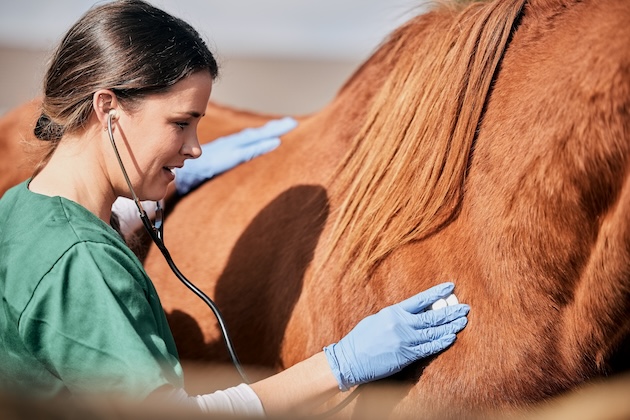
The Fun Fact:When humans eat something bad, we throw up. Dogs and cats vomit when they feel unwell too. But did you know that horses cannot vomit at all throughout their entire lives? This is an evolutionary and anatomical limitation. The connection between a horse's esophagus and stomach features an incredibly powerful muscular valve (the lower esophageal sphincter), which acts strictly as a "one-way street." On top of that, a horse's vomiting reflex arc is highly underdeveloped. If a horse consumes fermented or expanding food and gas builds up, their stomach would literally burst open before they could ever throw up to detoxify. Consequently, a seemingly routine case of "equine stomach ache / colic" is treated as a critical, life-threatening emergency in the veterinary world requiring all-out resuscitation!
Corresponding Field of Study:
- Large Animal & Equine Medicine:Horses are high-value animals with unique physiological structures, requiring vet students to study equine internal medicine and surgery as an independent, dedicated subject.
- Veterinary Gastroenterology:In-depth research into the digestive pathology of monogastric animals (like horses and pigs) versus ruminants.
Source: Shutterstock
3. Animal Behavior & Orthopedics
[A Purring Cat Doesn't Always Mean It's Happy? This Frequency Is Actually Their "Self-Healing Orthopedic Superpower"]
The Fun Fact: Many cat owners assume that when a cat purrs, it must be happy and content. However, veterinarians have discovered that cats also purr intensely when they are terrified, suffering from bone fractures, or even near death. Scientific research indicates that a cat's purr vibrates at a frequency between 20 and 150 Hertz (Hz). In medical science, this specific frequency range has been proven to promote bone regeneration, relieve pain, and accelerate muscle tissue repair. When a cat purrs, it is often activating its own "natural painkiller and orthopedic physical therapy"!
Corresponding Field of Study:
- Animal Behavior:Learning to accurately interpret the body language and behavioral responses of different animals under stress, pain, or illness.
- Veterinary Orthopedics & Physical Therapy:Researching animal bone growth, arthritis management, and post-operative rehabilitation sciences.
4. Comparative Anatomy
[Cows Have Four Stomachs? It’s Actually Just One Stomach Split Into "Four Distinct Chambers"!]
The Fun Fact:Most of us heard the saying "cows have four stomachs" when we were kids. From a veterinary anatomical perspective, however, a cow actually has only one stomach—it just evolved into four functionally distinct compartments: the rumen, reticulum, omasum, and abomasum. After a cow grazes, the food first enters the "rumen," which has a massive capacity of up to 100 liters and harbors billions of microbes to help ferment the foliage. Afterwards, the cow regurgitates the food back into its mouth to chew it again (cud-chewing or rumination) before passing it sequentially through the remaining three compartments for absorption. It is an incredibly sophisticated biological factory!
Corresponding Field of Study:
- Comparative Anatomy: This is the most hardcore foundational course in veterinary medicine. Students must simultaneously memorize and compare the completely different skeletal, vascular, and internal organ structures of multiple species (dogs, cats, horses, cows, sheep, pigs).
5. Exotic Pets & Wildlife Medicine
[Who Do You Call When Parrots or Turtles Get Sick? Vets Need to Master "Land, Sea, and Air" Interspecies Biology!]
The Fun Fact: If a student aspires to become an "Exotic Pets" veterinarian, the difficulty level spikes exponentially. For instance, a bird's bones are hollow to allow for flight; performing surgery on a parrot's fractured bone feels like working with fragile eggshells. When a turtle falls ill, it is encased in a rigid shell. To perform surgery or take an X-ray, vets often have to use micro-electric saws to "crack open the shell" and then use special dental resin to patch it back up post-surgery!
Corresponding Field of Study:
- Exotic Pet and Wildlife Medicine:Studying the unique physiology and surgical techniques required for reptiles, birds, small mammals (such as hamsters and chinchillas), and amphibians.
6. Veterinary Public Health
[Vets Don't Just Treat Animals—They Are the "First Line of Defense" Preventing Global Doomsday!]
The Fun Fact: Many people assume that a veterinarian's work has nothing to do with human health. However, the World Health Organization (WHO) points out that over 60% of emerging infectious diseases in human history (such as Mad Cow Disease, Avian Influenza, Rabies, Ebola, and even the coronaviruses we know all too well today) are "zoonotic"—meaning they are transmitted from animals to humans. Veterinarians working on the front lines in farms, customs checkpoints, and laboratories cut off transmission chains the moment an animal outbreak is detected, which frequently stops a global human pandemic right in its tracks.
Corresponding Field of Study:
- Veterinary Public Health & Epidemiology:Researching the transmission patterns of diseases between animals and humans, and participating in global health security and food safety oversight.
Source: Shutterstock
Overseas Studies: Carving Out a New Path for Animal Lovers
After exploring these fun facts, one cannot help but hold the all-encompassing discipline of veterinary science in the highest regard.
For students filled with passion who wish to avoid the fiercely competitive local route, veterinary schools in the UK and Australia are undoubtedly the premier choices for top-tier students worldwide. Overseas universities boast massive university farms, equine centres, and wildlife rehabilitation hospitals, offering true "land, sea, and air" clinical placement opportunities. Most importantly, the veterinary qualifications obtained in the UK and Australia are fully and directly recognised by the Veterinary Surgeons Board of Hong Kong for immediate local practice upon graduation.
The professional team at Synchro Overseas Education is ready to tailor a bespoke UK and Australian veterinary science study plan just for you. Whether it is UCAT / UCAT ANZ exam planning, strategic guidance on securing crucial clinical and animal handling experience required by top vet schools, MMI interview coaching, or university selection strategies for veterinary pathway programmes, we offer the most forward-thinking professional advice and global perspectives to help your children confidently achieve their dreams of becoming internationally registered veterinary surgeons. For more information or to book a consultation, please contact Synchro Overseas Education by calling 2111 1480 or via WhatsApp 5117 4380.