In the traditional public imagination, people working in delivery rooms are often lumped together under the old-fashioned term "midwives" or viewed as just a small sub-specialty of nursing.
However, if you head overseas to countries like the UK, Australia, or New Zealand, you’ll discover something surprising: Nursing and Midwifery are actually two entirely independent, equal-status professional degrees.They even have their own separate regulatory boards and registration systems.
What is the fundamental difference between these two professions? What beautiful misconcepti

source: Shutterstock
The Philosophy at Heart: Nurses Combat "Illness," Midwives Safeguard "Life Journeys"
To understand the difference between these two disciplines, we must first look at the world through their respective lenses:
Nursing: The Medical and Illness Model
Nurses care for patients. Whether dealing with an illness, an injury, or post-operative recovery, a nurse's duty is to assist doctors in diagnosing, managing, and treating conditions. In the philosophy of nursing, the client is typically in a state of non-health.
Midwifery: The Natural and Normal Physiological Model
Midwives don’t care for "patients"; they support expectant and new mothers. The core philosophy of midwifery dictates that pregnancy and childbirth are not "diseases," but rather a completely normal, physiological life stage for women. A midwife’s role is to guide and accompany mothers smoothly through this natural journey, only referring to an obstetrician if severe complications arise.
Core Authority:Nurses generally do not hold a legal license to deliver babies independently. In contrast, midwives are the absolute leaders of Low-Risk Normal Vaginal Deliveries. In many overseas countries, up to 70% to 80% of natural births are handled entirely by midwives from start to finish—without a doctor ever needing to step foot in the room.
4 Fascinating Facts About Midwives You Probably Didn't Know
1. The literal meaning of "Midwife" is "With Woman"
Many assume the term implies an "older woman or wife." However, in Old English, "mid"means "with," and "wife"means "woman."Put together, a midwife is literally "someone who walks alongside women,"which is beautifully romantic.
2. They are "wizards" who see through the womb using just hands and ears
Experienced midwives can perform an abdominal palpation using only their hands to precisely figure out the baby's position, identify breech presentations, and even accurately estimate the baby's weight. They also frequently use a trumpet-shaped wooden stethoscope called a Pinard Stethoscopepressed against the mother's abdomen to listen to the fetal heartbeat. Because wood transmits sound purely, it eliminates electronic feedback and machine noise.
3. They rely heavily on "acting skills" and psychological tactics
Labor pain can score up to a level 10, and many mothers experience moments of panic and emotional collapse halfway through. In these moments, a midwife's most powerful tool isn't medication—it’s her voice and gaze. They use an incredibly firm, gentle, yet authoritative tone to pull the mother back from the brink of pain, coach her through breathing, or even join her in a "labor dance" to distract from the contractions.
4. Hong Kong operates under a very unique entry system
- Overseas (UK, Australia, New Zealand): They implement a "Direct-entry" system. High school graduates can directly enroll in a 3-year Bachelor of Midwifery degree, meaning they never have to work as a general nurse.
- Hong Kong:The region still adheres to a traditional "Nursing Specialization" system. You must first complete a 5-year nursing degree and qualify as a Registered Nurse (RN) before you can apply for postgraduate training in midwifery.
Training and Education Showdown: Hong Kong vs. Overseas
According to official guidelines from the Midwives Council of Hong Kong (MWCHK), there are distinct numerical contrasts in academic output and clinical training requirements between Hong Kong and international programs:
1. The Golden Ratio of Theory vs. Clinical Placement
- Hong Kong Standards:Guidelines strictly dictate that the curriculum must consist of at least 30% theory and at least 60% clinical placement. Hong Kong heavily leans into high-intensity, hands-on action, ensuring students gain dense practical experience in public hospital labor wards.
- Overseas Standards:Countries like the UK or Australia typically adopt a more balanced 50% theory + 50% clinical placementapproach, placing greater academic emphasis on critical thinking and research methodologies.
2. Graduation Clinical Benchmarks (Delivery Quotas)
To successfully graduate and register, students in both regions must meet clear targets for the number of cases they personally manage:
- Antenatal Checks: Hong Kong requires students to perform check-ups for no fewer than 50 pregnant women. Overseas standards vary but focus heavily on comprehensive, end-to-end care.
- Deliveries Completed: Hong Kong requires students to participate in at least 30 delivery cases, during which they must personally manage the birth and deliver the placenta, umbilical cord, and fetal membranes. Overseas requirements (UK and Australia) maintain a similar threshold of roughly 30–40 cases.
- Continuity of Care: This is the definitive overseas highlight. International students must follow 10–20 specific expectant mothers from early pregnancy all the way through to postpartum, attending every check-up and the delivery itself. In contrast, Hong Kong utilizes a ward rotation system due to its highly concentrated medical infrastructure.
3. Quality Assurance in Student-to-Teacher Ratios
The Hong Kong guidelines enforce strict numerical quality controls for practical training:
- The obstetric department affiliated with the school must handle no fewer than 500 births annually to guarantee sufficient clinical learning opportunities.
- The overall teacher-to-student ratio cannot exceed 1:15.
- During labor ward placements, each clinical instructor can supervise a maximum of 8 students at any one time.
In comparison, overseas universities often have larger lecture classes but rely heavily on a 1-to-1 mentorship model led by on-duty hospital midwives during clinical placements.
Which Path Suits You Best?
Midwives trained in Hong Kong are "double-threat," highly resilient specialists(backed by a 5-year nursing foundation plus 1.5 years of high-density delivery room combat). Upon graduation, they are ready to handle high-pressure, high-risk obstetric emergencies.
Meanwhile, internationally trained midwives are specialists who "drill down vertically"into advocating for natural, physiological childbirth.
If you love the joy of welcoming new life and possess exceptional empathy combined with high stress tolerance, midwifery is undoubtedly a specialty that offers an unparalleled sense of accomplishment!
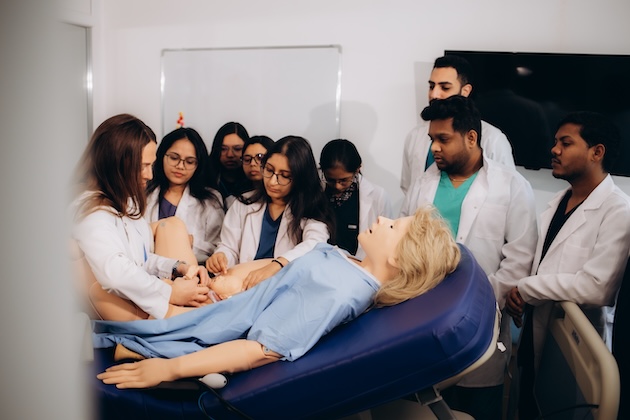
source: Shutterstock
Welcoming New Life with Autonomy: Secure Your UK & Australian Direct-Entry Midwifery Place with Synchro Overseas Education
If you are captivated by the joy of welcoming new life and possess a blend of profound empathy and high stress-resistance, midwifery is undoubtedly a specialty that offers an unparalleled sense of professional accomplishment! Do not let the local prerequisite of completing a five-year nursing degree limit your aspirations; by looking abroad, you can pursue a far more direct and autonomous path into this sacred profession.
The professional team at Synchro Overseas Education is ready to tailor a bespoke UK and Australian Midwifery study plan just for you. Whether it is strategic planning for the 3-year "Direct-entry Bachelor of Midwifery" programmes overseas, navigating mandatory clinical requirements such as cases of deliveries and "Continuity of Care" placement tracking, interview coaching, or mapping out your registration pathway with the Midwives Council of Hong Kong (MWCHK) upon graduation, we offer the most forward-thinking professional advice and global perspectives. We are here to help your children confidently achieve their dreams of becoming internationally recognized midwives. For more information or to book a consultation, please contact Synchro Overseas Education by calling 2111 1480 or via WhatsApp 5117 4380.