"Are you having trouble seeing clearly? let's get you fitted for a new pair of glasses." In the minds of many students and parents, the work of an optometrist seems completely identical to "testing prescriptions and fitting glasses" at a local optical shop.
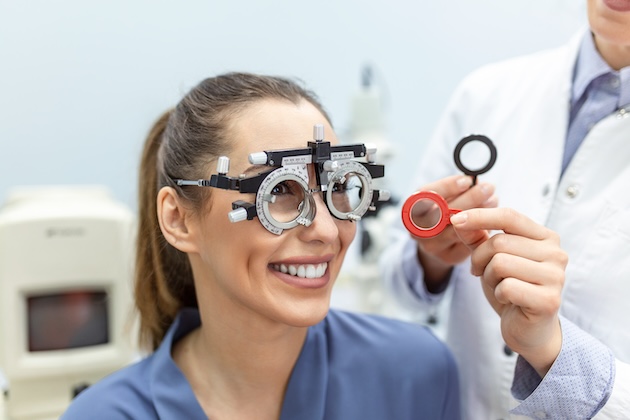
If you think that way, you are seriously underestimating this highly lucrative healthcare auxiliary major that faces a chronic shortage in Hong Kong! The eyes are the windows to the soul, and an optometrist is actually the "first line of defense for eye health" within the primary healthcare system. They do not just check your prescription; they use high-tech equipment to examine the fundus (the back of the eye), flagging severe conditions like glaucoma, retinal detachment, or even fundus bleeding caused by diabetes!
Source: Shutterstock
Today, let's explore a few career fun facts regarding the mysterious grading system of Hong Kong optometrists, and find out which overseas university degrees are directly recognized by the Optometrists Board of Hong Kong, allowing students to return and practice directly via an "overseas degree"!
1. HK Practice Is Split into 4 Registration Levels? Only "Part I" Can Administer Eye Drops!]
The Fun Fact: Many people are unaware that when you walk into different optical shops or eye clinics in Hong Kong, the registration level printed on the optometrist's badge dictates completely different professional boundaries. Under Hong Kong law, the Register of Optometrists is divided into four distinct parts (Part I to Part IV):
- Part I: This is the golden standard! Only optometrists in this category are legally permitted to use diagnostic pharmaceutical agents (such as mydriatics for dilating pupils and topical anaesthetics). They have received comprehensive university academic and clinical training, enabling them to perform the most thorough clinical eye examinations.
- Parts II, III, and IV: These professionals generally registered during the early days through competency assessments or short-term certificate programs. While highly experienced in testing prescriptions and fitting glasses, they cannot administer any diagnostic drugs, nor can they independently conduct high-risk clinical eye examinations.
The Admission Pain Point: Currently in Hong Kong, The Hong Kong Polytechnic University (PolyU) is the sole institution offering a recognized Bachelor of Science (Honours) in Optometry, allowing graduates to register directly as Part I optometrists. Due to this exclusivity, its JUPAS admission scores are incredibly high—rivaling radiography and physical therapy—leaving many students interested in eye care facing a daunting barrier.
2. An Optometrist Is the "Physician & Family Doctor" of Eyes, While an Ophthalmologist Is the "Surgeon"]
The Fun Fact: Many people confuse the division of labour between an Optometrist and an Ophthalmologist. Simply put:
- Optometrist: They are primary eye care specialists. When you experience blurred vision, dry eyes, or suspect color blindness or amblyopia (lazy eye), an optometrist should be your first point of contact. They correct vision through optical principles (such as fitting glasses or designing Ortho-K/Orthokeratology lenses to control myopia progression) and diagnose eye diseases.
- Ophthalmologist: They are specialized medical doctors (MDs) who graduated from medical school. If an optometrist examines your fundus and finds severe cataracts, macular degeneration, or determines that you require laser surgery to repair a torn retina or micro-incision surgeries, they will write a referral letter transferring you to an ophthalmologist for surgical interventions or prescription medical eye drops (such as antibiotics).
3. The "Red House on a Grassland" Is Not Just There to Lock Your Focus
Whenever you get your glasses fitted or undergo an eye checkup, you have undoubtedly seen this classic image: a straight, endless road with a small red house (or a hot air balloon) sitting at the horizon on a green meadow. As you stare at it, the image suddenly goes blurry, then sharpens back up.
- The Fun Fact: This machine is called an autorefractor. The true purpose of that image is to guide your eyes to look into the far distance—essentially focusing at "optical infinity."
- When the human eye looks at nearby objects, the ciliary muscles inside the eyeball automatically contract to adjust focus—a biological process known as accommodation. If your eyes are actively straining or trying to focus during the test, the machine will miscalculate your prescription, resulting in an artificially high near-sightedness reading (known as pseudomyopia).
- By having you look at that distant house or hot air balloon, the machine virtually pushes the image into the far distance. This "tricks" your eye muscles into fully relaxing, allowing the optometrist to capture the most accurate, resting optical data of your eyes within just a few seconds.
4. "Color Blindness" Is Not as Hopeless as You Think—Optometrists Can Use Physics to "Trick" the Brain
Many people assume that color blindness or color deficiency is an unfixable genetic defect, condemning individuals to a muted, washed-out world forever.
- The Fun Fact: Modern optometrists can utilize specialized optical filtering lenses (such as EnChroma lenses) to assist patients with color vision deficiencies. Color deficiency typically occurs because the wavelength sensitivities of the red- and green-detecting cone cells (cones) in the retina overlap excessively, making it difficult for the brain to tell them apart.
- By applying principles of physical optics, optometrists use these engineered lenses to precisely filter out the overlapping sharp wavelengths of light. This effectively widens the contrast gap between red and green channels. The moment a patient puts these glasses on, the brain is successfully "tricked," allowing them to perceive a true rainbow or distinguish traffic lights clearly for the very first time.
Source: Shutterstock
Overseas Educational Pathways: How to Register for Part I Directly via an Overseas Degree?
Fortunately, the registration system of the Optometrists Board of Hong Kong is highly internationalized. Its "List of Recognized Non-local Qualifications" explicitly details premier optometry degrees from the UK, Australia, New Zealand, the US, and Canada.
As long as a student completes the designated university curriculum abroad and successfully obtains the corresponding local practicing registration (such as the GOC in the UK or the Optometry Board of Australia), they can apply to register directly as a Part I practicing optometrist in Hong Kong upon their return, exempt from local licensing examinations or subject to standard verification!
Below is a curated selection of premier overseas institutions highly popular among Hong Kong students that are explicitly included in the Hong Kong Board's recognized list:
1. Australia and New Zealand
Optometry programs in Australia and New Zealand put an immense emphasis on clinical clerkships, leading to exceptional employment rates across both countries:
The University of New South Wales (UNSW) — Australia
- Recognized Degrees: Dual degree programs featuring the Bachelor of Optometry / Bachelor of Science (Computer Science) or the modern Bachelor of Vision Science / Master of Optometry pathways.
The University of Melbourne — Australia
- Recognized Degree: Doctor of Optometry (OD) (Melbourne University offers this at a postgraduate level, enjoying a stellar global reputation).
Queensland University of Technology (QUT) — Australia
- Recognized Degrees: Dual degree package consisting of the Bachelor of Vision Science + Master of Optometry.
The University of Auckland — New Zealand
- Recognized Degree: Bachelor of Optometry (BOptom).
2. The United Kingdom
Optometry programs in the UK generally span 3 years for a bachelor's degree. Upon graduation, students complete a local "Pre-registration Year" and pass the necessary professional assessments to secure full General Optical Council (GOC) registration before returning to Hong Kong:
Cardiff University (A prestigious Russell Group member with a long-standing history in optometry)
- Recognized Degree: Bachelor of Science in Optometry.
The University of Manchester
- Recognized Degree: Bachelor of Science in Optometry.
Aston University (Home to one of the most technologically advanced university optometry clinics in the UK)
- Recognized Degree: Bachelor of Science in Optometry.
Ulster University
- Recognized Degree: Bachelor of Science (Honours) in Optometry.
Pursuing an optometry degree abroad not only offers more flexible entry thresholds compared to PolyU, but also exposes students to an incredibly vast array of primary healthcare clinical cases (for instance, optometrists in Australia enjoy broader diagnostic and autonomous prescription rights at the grassroots level).
When selecting an overseas university, students must ensure the chosen program leads directly to full professional registration in that host country. The Optometrists Board of Hong Kong heavily considers an applicant's "local practicing registration status" as a vital criterion when evaluating non-local qualifications.
The First Line of Defence for Vision: Chart Your UK & Australian Optometry Part I Pathway with Synchro Overseas Education
Now that you understand the crucial role of an optometrist as the "primary care family doctor" for eye health, along with the clear qualification pathways back to Hong Kong, would you and your parents prefer the accelerated academic structure of British universities, or the broader clinical diagnostic authority offered by Australian institutions?
The professional team at Synchro Overseas Education is ready to tailor a bespoke UK and Australian Optometry study plan just for you. Whether it is matching your academic goals with universities on the Radiographers and Optometrists Board's List of Recognized Non-local Qualifications, strategic guidance on securing local practicing licenses like the GOC (UK) or OBA (Australia), or mapping out your long-term career to return and register directly under Part I of the Supplementary Medical Professions Ordinance in Hong Kong, we offer the most forward-thinking professional advice and global perspectives. We are here to help your children confidently achieve their dreams of becoming registered optometrists. For more information or to book a consultation, please contact Synchro Overseas Education by calling 2111 1480 or via WhatsApp 5117 4380.