Unsung Heroes Preventing Amputation
"If you get corns or fungal nail infections on your feet, can't you just buy lotion from a pharmacy or get a pedicure master to sort it out?" In the eyes of many students and parents, foot issues seem like "minor ailments"—something best left to beauty salons or foot massage shops.
If you think that way, you are missing out on an incredibly lucrative, high-demand allied health discipline: Podiatry!
The average person walks about 110,000 miles in a lifetime (the equivalent of circling the globe four times), with our feet bearing the entire weight of our bodies. Podiatrists are the top engineers for this "human foundation." In Hong Kong, this profession offers high starting salaries and stable career paths. It is also an exceptionally rare specialty, with fewer than 100 practicing professionals across the city. Virtually every public hospital has this department, making it deeply connected to public health and daily life.

Source: Shutterstock
Today, let's unpack some fascinating fun facts about podiatry and look at its exceptional employment prospects!
1. The Healthcare "Bomb Disposal Experts": Much More Than Cutting Toenails
[Fun Fact: They Are Not "Pedicurists"—Their Job Is to "Save the Patient's Feet"!]
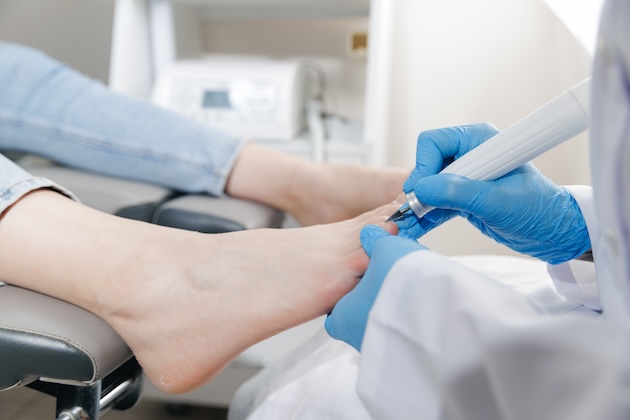
Many people assume podiatrists only help the elderly trim toenails or scrape away corns. In reality, they act as "bomb disposal experts" in hospitals. The podiatry departments in public hospitals handle high-risk clinical cases every day:
- Diabetic Foot: Diabetic patients often suffer from peripheral neuropathy. Even if they step on a nail or experience severe ulceration, they can be completely unable to feel the pain. If a small wound gets severely infected, they face amputation.
- Saving the Family Breadwinner: Podiatrists utilize advanced wound offloading techniques, craft custom orthotics, and collaborate with surgeons and diabetes specialist nurses to pull patients back from the brink of amputation. For many families, saving a foot means preserving a livelihood.
- A Broad Scope of Treatment: Beyond diabetic foot care and deep ulcerations, they treat severe ingrown toenails (onychocryptosis), structural joint pain caused by flat feet, plantar fasciitis, and even foot trauma in infants as young as six months old.
2. Addressing Daily Headaches Close to Home
Beyond saving lives in hospitals, an individual's walking posture and shoe-shopping habits all fall under a podiatrist's domain. Here are two common misconceptions they fix for urbanites every day:
[Fun Fact: Flat Feet Cannot Be Fixed by Simply "Buying Orthopedic Shoes"! Random Purchases Can Accelerate Joint Degeneration!]
When parents notice their child has flat feet, or when they experience foot pain after walking for a while, their first instinct is often to visit a retail shoe store to buy a pair of shoes advertised with "arch support" or off-the-shelf insoles. This is actually highly dangerous! The root cause of flat feet, the degree of overpronation, leg length discrepancies, and muscle tone vary completely from person to person.
Mass-produced insoles are like over-the-counter reading glasses; wearing them haphazardly forces bones into incorrect positions. Podiatrists are specialists in biomechanics. Through computerized gait analysis, they precisely calculate which joint bears excessive pressure during your stride. Then, just like a doctor writing a prescription, they custom-make medical-grade foot orthoses for you. This is not a simple matter of propping up the arch; it uses precise angular adjustments to realign your entire skeletal framework, protecting your knees and lumbar spine for the future.
3. A Wide-Open Blue Ocean: Fewer Than 100 Practitioners in HK
[Fun Fact: Hong Kong Currently Offers "Zero" Local Higher Education Programs—100% Reliant on Overseas Study!]
- The Educational Obstacle: Why is this profession so mysterious in Hong Kong? Because not a single university in Hong Kong offers a degree program in podiatry.
- An Extremely Starved Market: Due to zero local supply, every podiatrist in Hong Kong's public hospitals and private clinics graduated overseas (mainly from the UK, Australia, and New Zealand). The current pool of practitioners is remarkably small—recent Hospital Authority statistics show only around 50 resident podiatrists in public hospitals, and fewer than 100 across the entire territory including private practice. With an aging population and rising diabetes rates, the demand for these professionals is skyrocketing.
4. Fully Funded by the Hospital Authority! Captivating Career Prospects and Promotion Pathways
For students wishing to join the healthcare sector but worried about the fierce competition of the local DSE, podiatry is an exceptionally high-value golden pathway:
Remuneration Package (Using the Hospital Authority as an Example)
- Podiatrist II (Entry Level): Upon returning to Hong Kong and joining the Hospital Authority, the starting salary lands at Point 13 of the General Minimum Pay Scale, commencing at approximately HK$34,070 per month (rising up to HK$55,233).
- Podiatrist I / Senior Podiatrist: After completing a designated period of service and passing performance appraisals, professionals can be promoted to Tier I, with monthly salaries reaching HK$53,980 to HK$81,510. Higher administrative roles, such as Department Manager, lie further up the ladder.
The Official "Tuition-Free" Overseas Training Scheme
To combat the severe manpower shortage, the Hospital Authority (HA) regularly launches its "Allied Health Overseas Training Sponsorship Scheme"!
- The HA fully subsidizes the entire program (covering around HK$400,000 to HK$500,000 in tuition fees) to send selected local students to top universities in the United Kingdom to pursue a Bachelor’s degree in Podiatry.
- Upon graduation, students return directly to Hong Kong to fulfill a 5-year service contract. This guarantees immediate employment right out of university, removing both job-hunting stress and financial tuition burdens—making it an incredible incentive for parents and students alike!
5. How to Enter the Profession? Overseas Educational Pathways
Students simply need to graduate with an accredited degree overseas and secure professional registration in their host country (such as with the HCPC in the UK or the Podiatry Board of Australia). Upon returning to Hong Kong, they can apply for their practicing certificate from the relevant authority and begin working directly in public or private medical institutions.
Source: Shutterstock
The Unsung Heroes of Human Foundations: Launch Your Podiatry Career in an Exclusive Market with Synchro Overseas Education
The demand for podiatrists within public hospitals remains uninterrupted, and with overseas entry thresholds being far more flexible than traditional local medical faculties, this presents a golden opportunity for students to ascend into the ranks of elite healthcare professionals.
The professional team at Synchro Overseas Education is ready to tailor a bespoke UK and Australian Podiatry study plan just for you. Whether it is strategic planning for the Hospital Authority's overseas training subsidy schemes, securing local practicing licenses such as the HCPC (UK) or the Podiatry Board of Australia, academic profiling for essential lower-limb anatomy and biomechanics prerequisites, or mapping out your pathway to return to Hong Kong for immediate public hospital employment, we offer the most forward-thinking professional advice and global perspectives. We are here to help your children confidently achieve their dreams of becoming registered podiatrists. For more information or to book a consultation, please contact Synchro Overseas Education by calling 2111 1480 or via WhatsApp 5117 4380.